
The Evolution of Elegance
In the rarefied air of Chelsea and Knightsbridge, the definition of the 'trophy home' is undergoing a radical metamorphosis. Where once the focus was strictly on historical preservation and gilded ornamentation, today’s architectural elite are carving out a new, more nuanced path. Arabella Sinclair explores why the modern UHNW buyer is looking beyond the traditional façade to find sanctuary in structural innovation.
The Subterranean Renaissance
Perhaps the most significant shift in prime London real estate is the descent. We are no longer merely looking up at soaring ceilings, but down into vast, engineered wonderlands. Architect Julian Hemsley notes, 'The modern London townhouse is a three-dimensional puzzle. We are finding that the most profound expressions of luxury are now happening two stories below ground, where we can manipulate light and volume without the constraints of local planning restrictions.' These cavernous spaces now host private cinemas that rival the BFI, climate-controlled wine cellars for rare vintages, and swimming pools finished in Bisazza glass mosaic that shimmer with a celestial luminescence.
Biophilic Brutalism
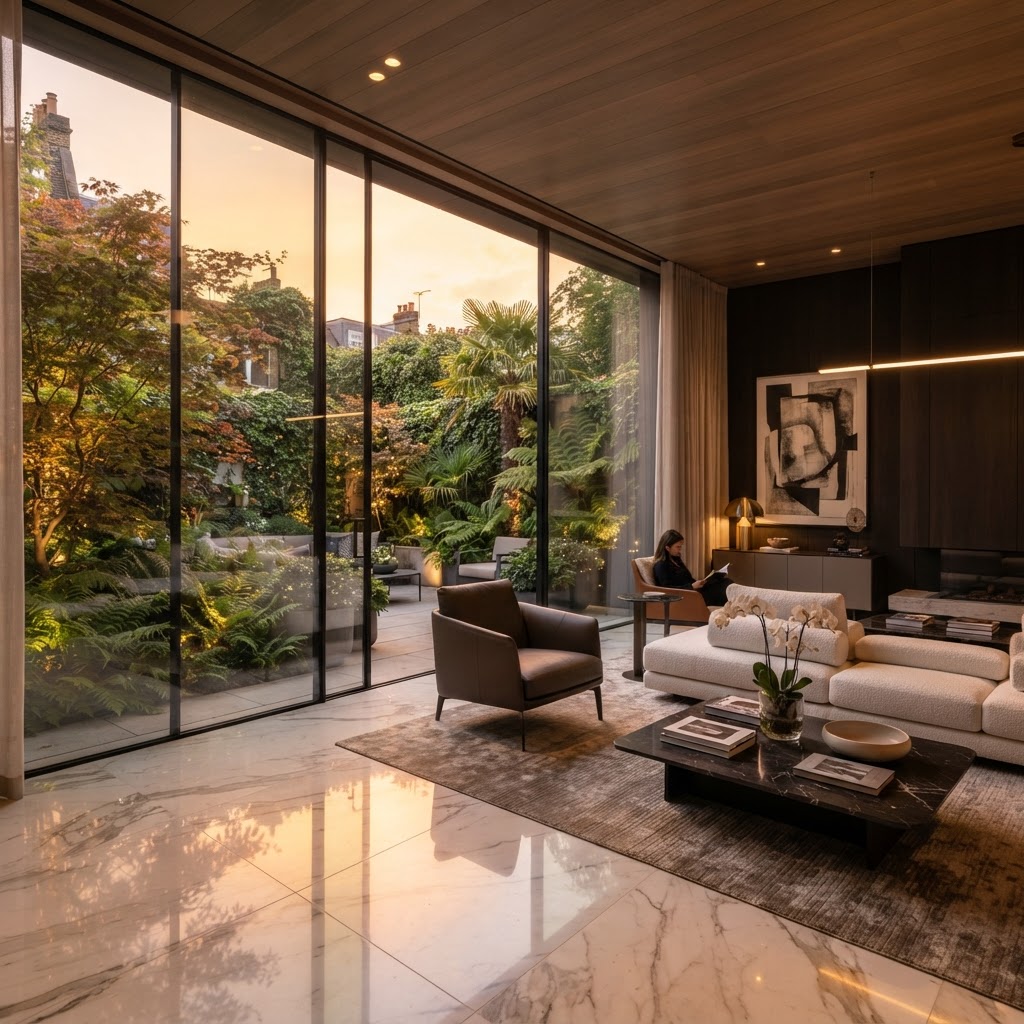
There is a growing trend—or perhaps an urgent necessity—for greenery within the urban footprint. The 'biophilic' movement, championed by firms such as Foster + Partners, has moved from corporate offices to the private residence. We are seeing central courtyards enclosed in frameless glass, creating winter gardens that invite the serenity of a country estate into the heart of a bustling metropolitan street. 'It is about breaking the boundary between the hard stone of Chelsea and the organic wildness of the natural world,' explains interior designer Elara Vance, whose recent project in a grade-II listed Knightsbridge terrace utilized vertical moss walls and retractable skylights to bridge the divide.
The future of luxury isn't just about the scale of the footprint; it is about the fluidity of the living experience.
The Craft of Customisation
For those seeking the ultimate in bespoke living, the new architectural direction favours 'The Sculptural Home.' This involves moving away from the rectilinear constraints of traditional layouts in favour of fluid, organic curves. Using CNC-milled marble and bespoke metalwork from workshops like those found in the quiet corners of Italy, these residences are less about 'rooms' and more about 'volumes.' Lighting, too, has evolved into a fine art, with installations from companies like Viabizzuno transforming functional hallways into immersive art galleries. This is architectural theatre—a stage for a life well-lived, where every sightline is curated, and every material, from hand-applied polished plaster to reclaimed English oak, serves a deeper narrative.
The Country Estate Reimagined
As the gaze shifts outward to the home counties, the architectural conversation remains equally vibrant. Luxury estates are moving away from the austere formality of the past. We are seeing a synthesis of 'English Heritage' and 'Scandinavian Minimalism.' Think Cotswold stone facades married with expansive, floor-to-ceiling floor-to-ceiling glass pavilions. These structures exist in dialogue with the landscape, ensuring that even within the most sophisticated interiors, the horizon remains the hero.
As we look toward 2027, it is clear that the architecture of the ultra-prime market is not merely about status; it is about intimacy and sensory impact. It is a return to a philosophy where the home is not a static object, but a living, breathing testament to the vision of its inhabitant.