
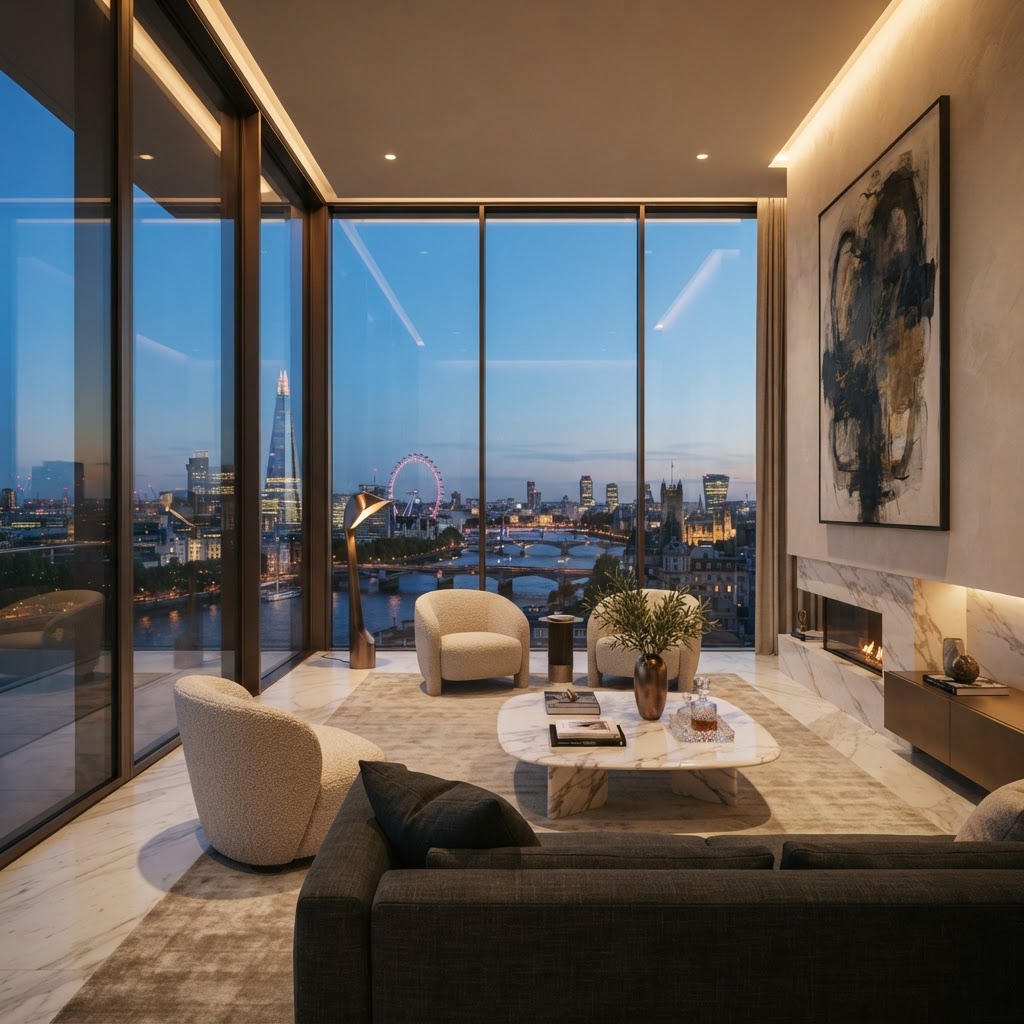
In the rarefied air of London’s most coveted postcodes, a profound evolution is underway. The traditional Victorian townhouse, once defined by rigid compartmentalisation and gilded formality, is undergoing a quiet, radical metamorphosis. As we navigate the latter half of the decade, the ultra-prime property market has pivoted away from the ostentatious displays of wealth that defined the early 2000s, favoring instead a philosophy of 'curated permanence' and invisible luxury.
The Biophilic Revolution
Stepping into a newly reimagined lateral penthouse in Knightsbridge, one is struck by an absence of noise—both auditory and visual. According to lead architect Julian Vane, whose recent work on the Cadogan Estate has set a new benchmark, the current trend is the 'dissolution of the boundary.' The architecture is no longer merely housing the resident; it is actively nurturing them. We are seeing the rise of internal light wells, sprawling winter gardens that utilise automated glass louvres by Schüco, and the integration of living walls that breathe, literally, alongside the occupants.
The modern luxury home is less a static structure and more a living, breathing ecosystem that responds to the circadian rhythms of its inhabitants.
Craftsmanship Over Convenience
The discerning collector of real estate is now, more than ever, a patron of the arts. In the refurbishment of Chelsea’s most historic dwellings, we see the return of the artisan. Bespoke joinery, commissioned from workshops in the Cotswolds using reclaimed English oak, is now prioritised over generic high-end Italian imports. Interior luminary Elena Rossi notes, 'There is a fatigue surrounding the mass-produced luxury aesthetic. My clients are requesting surfaces that tell a story—travertine quarried from specific veins in Tuscany, or hand-forged bronze hardware that patinas beautifully over a lifetime.' This tactile engagement is the new ultimate status symbol.
The Sanctuary Estate
Beyond the city walls, the definition of the 'Country Estate' has likewise been rewritten. The grand, drafty halls of the past are being reconfigured into hybrid spaces. We are seeing the emergence of the 'private wellness wing'—a standard now expected in the Cotswolds and the Home Counties. These aren't mere gyms; they are holistic sanctuaries featuring hyperbaric chambers, cold-plunge pools by NOHrD, and circadian-rhythm lighting systems that mimic the natural sun cycle. The modern estate is designed for longevity, not just in structure, but in vitality.
Sustainability as the New Standard
Perhaps the most compelling shift is the integration of cutting-edge, 'invisible' sustainability. Today's billionaire homeowners are demanding net-zero capabilities without sacrificing the aesthetic integrity of their heritage façades. It is the silent marriage of smart-home technology, such as the Crestron Home OS, with geothermal ground-source heat pumps that are invisible to the eye but monumental in their impact. The luxury home of 2026 is a masterpiece of stealth engineering.
As we look to the future, the message is clear: the new direction of architecture is one of quiet intelligence. It is a return to the fundamentals of space, light, and materiality, delivered with an uncompromising commitment to the human experience. Whether perched above the canopy of Hyde Park or nestled in a sprawling valley, these homes are no longer just assets; they are the ultimate legacy.